The Dark Web: Separating Fact from Fiction
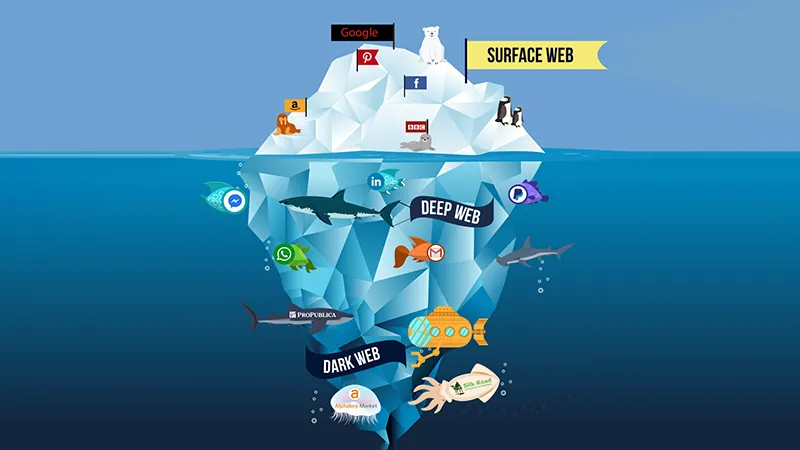
Uncovering the Truth About the Dark Web: Debunking Myths and Exploring Its Role in Privacy and Technology.
Most people hear the term "dark web" and picture an underground syndicate of hitmen and illegal drug cartels. The reality is strictly structural. The dark web is a subset of the internet that standard search engines cannot index and normal browsers cannot access. It requires specific overlay protocols to navigate.
To understand what the dark web actually is, we must strip away the assumptions and examine the network architecture directly.
Fiction vs. Fact
Fiction: The Dark Web is a Massive Criminal Underworld
Fact: Illegal marketplaces certainly exist, but their scale is a rounding error against the global physical trade. Even at their record peak in 2021, darknet markets generated an estimated $2.7 billion in revenue, equivalent to roughly 1.5% of retail drug sales in North America and Europe, according to the UNODC World Drug Report 2023. Earlier estimates put the share even lower, at a fraction of a percent of the retail market. Either way, the overwhelming majority of the illegal trade moves through traditional physical supply chains, not hidden servers. Worth noting: darknet sales rose in 2020 and 2021 before trafficking began migrating to social media and encrypted messengers. The market is small, but it is not static, and it is increasingly leaving the dark web entirely.
Fiction: Using Tor Means You Are "On the Dark Web"
Fact: There is a fundamental difference between anonymous surfing and accessing hidden services. If you open the Tor Browser and search for a product on Google, you are not on the dark web. You are browsing the surface web anonymously by hiding your IP address from data brokers. The actual dark web consists of hidden services (like .onion sites). These protocols are designed to hide the location and identity of the server hosting the website, not just the user visiting it.
Fiction: The Dark Web Runs on Blockchain
Fact: There is a critical distinction between network architecture and payment rails. The underlying routing protocols of the dark web have nothing to do with Web3 or blockchain; they are peer-to-peer networking architectures that predate Bitcoin. Cryptocurrency, however, is genuinely central to how darknet markets operate, as a payment mechanism. The networks themselves do not run on a blockchain, but the illicit commerce hosted on them relies almost entirely on cryptocurrency ledgers.
Fiction: Tor Guarantees Perfect Anonymity
Fact: Tor encrypts your data, but it cannot hide the laws of physics. If an adversary controls or monitors both your Entry Node and your Exit Node, they can strip away your anonymity using traffic analysis. They do not break the cryptography; they monitor traffic volume and timing. If a specific volume of data enters the network from your IP address at the exact moment a matching data stream leaves their exit node heading to a specific website, they can correlate the two flows and link you to the destination. Perfect anonymity does not exist.
Under the Hood: How Anonymity Actually Works
To discuss privacy accurately, you have to understand the routing mechanics. Here is how the three major networks handle data transmission.
Tor (The Onion Router): Think of Tor like putting a letter inside three locked boxes, one inside the other. When you connect, the protocol selects three random volunteer servers (an Entry, a Middle, and an Exit node) and encrypts your data three times. As your traffic hits each server, one layer of encryption is unlocked, revealing only the next destination. No single server knows both who you are and what website you are visiting, assuming the system is not compromised by the traffic correlation attack described above.
I2P (The Invisible Internet Project): While Tor builds a single path for a data stream, I2P uses a technique called garlic routing. Instead of sending messages one by one, it bundles multiple messages (or "cloves"), such as different instructions from the same sender, into a single encrypted packet. It is like packing several distinct directives into one delivery truck. An observer analyzing the network cannot easily determine the payload structure or the ultimate destination of the individual instructions.
Hyphanet: Known as Freenet prior to 2023, this network is a decentralized storage locker rather than a proxy for live websites. It takes files, fragments them, encrypts the pieces, and scatters them across the hard drives of everyone participating in the network. Users can host or retrieve data with plausible deniability, because the protocol obfuscates both who published the data and whose hardware is currently storing the fragments.
The Bottom Line
The core paradox of the dark web is rooted in its engineering. The exact same mathematical and routing properties required to protect dissidents from state-level surveillance are required to protect illicit marketplaces. You cannot build a network protocol that successfully resists authoritarian censorship without simultaneously creating a space where a state cannot enforce its laws. The architecture is absolute, and the trade-offs are hardcoded into the network itself.
Sources: UNODC World Drug Report 2023 (darknet market revenue and share of retail sales); UNODC World Drug Report 2022, Booklet 1, p. 56 (darknet markets as a "very small share of drug transactions"); RAND Europe, cryptomarket drug-trade estimates.