I Wrote About AI's Future in 2023. Here's What I Got Right and Wrong.
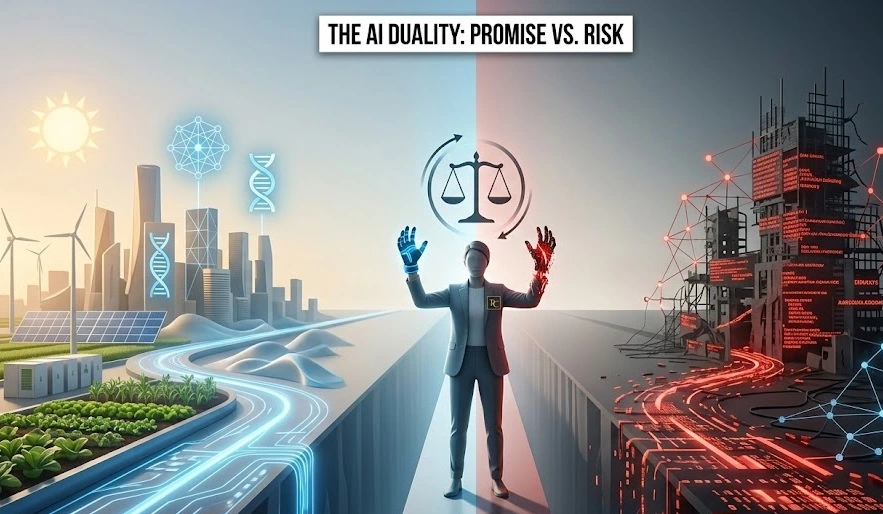
Three and a half years ago I published a benefits-and-risks piece about AI. Predictions are cheap when nobody checks them, so I am checking mine. Grades below, with sources, and no grading on a curve.
Why bother
In January 2023, barely a month into the ChatGPT era, I wrote that AI would reshape medicine, transport, energy, and education. I also listed the risks: bias, misinformation, job loss, loss of control, and concentration of power.
The interesting result is not my win-loss record. It is that the things I was confident about and the things that actually mattered were rarely the same, one of my "benefits" turned out to be a "risk" wearing the wrong label, and my worst blind spot in 2026 was a warning I got right in 2023 and then almost forgot to track.
The benefits, graded
Medicine: right. This was my most confident prediction and it held up. By 2025, meta-analyses put AI diagnostic imaging at pooled sensitivity and specificity above 90%, and about 54% of US hospitals with more than 100 beds report using AI in radiology, mostly for interpretation and triage. But I got it right for shallow reasons. The nuance that mattered is that AI plus a radiologist beats AI alone, and that cleared tools often lose accuracy when deployed in a hospital different from the one they were trained on. That second point is my own "bias" risk showing up inside my favorite benefit. I praised the tool and missed that its weakness and its danger were the same property.
Transportation: too early. I hedged this one deliberately in 2023, writing that "safer than humans" was a plausible destination, not a proven fact. That held. Waymo now runs real driverless service, over 20 million trips on a fleet of roughly 3,000 vehicles, but in only about six live metro areas with a long expansion list. City by city, geofence by geofence, is the actual shape of it. Real, but slower and narrower than the hype I was reacting against.
Energy and climate: backwards. This is the one I got most wrong. In 2023 I filed AI under "helps with climate and energy," citing data-center efficiency gains, and added a caveat that training models costs power. I had the headline and the caveat in the wrong proportion. The caveat became the story. Data-center electricity demand jumped 17% in 2025, far outpacing the ~3% growth in overall use, AI computation alone is projected to draw at least 70 TWh in 2026 (about what Austria uses), and grid power is now the binding constraint on AI expansion. In Ireland, data centers already exceed 20% of national electricity demand. I labeled AI a tool for reducing energy use. On net, it is a large new source of demand.
Education: happened, with the rot I predicted. Personalized AI tutoring arrived fast once language models did, and so did students handing in essays the same tools wrote. Both came true at once. Neither the promise nor the problem has fully settled, so I will call this accurate but unfinished.
The risks, graded
Bias: confirmed, ongoing. My best-supported risk in 2023, and nothing since has softened it. It remains the failure mode that shows up everywhere, including inside the medical-AI success story above. No grade change: right, and it stays right.
Concentration of power: right, and I almost skipped it. In 2023 I warned that frontier models need compute and capital that concentrate influence in very few hands. In the first draft of this retrospective I did not grade it at all, which is precisely the burial I said I would avoid, so I am fixing that here. The warning was correct. Roughly five firms now control frontier model development; by some measures OpenAI and Anthropic alone account for around 90% of the category's valuation. The economics make this structural: training costs are enormous and fixed, serving costs are tiny, so scale wins. The energy story fed straight into it, since only a handful of players can secure gigawatts of power and billions in silicon. The one honest hedge: open-weight models remain a real counter-current, so this is a strong oligopoly, not a sealed monopoly. But the direction I flagged is the direction it went.
Job displacement: I graded this too comfortably the first time. In 2023 I refused to quote a single confident unemployment number, and that restraint was right. Where I went soft was in this retrospective's first pass, where I called the damage a "painful but manageable reallocation" because macro projections (the WEF's 2025 outlook still forecasts net creation, 170 million new roles against 92 million displaced through 2030) said the totals net out. That misses the mechanics. Entry-level tech hiring has fallen sharply, by most measures somewhere in the 60-70% range, employment for developers aged 22 to 25 is down nearly 20% since 2024 while older developers kept gaining, and an IDC/Deel survey found 66% of enterprises planning to cut entry-level hiring. Here is the part the net number hides: you build senior engineers by putting juniors through the boring work, the debugging, the boilerplate, the tracing of stack outputs. Automate that away and you do not get more seniors later, you get fewer. That is a threat to the training pipeline, not a simple reallocation. I will not overclaim it either: the market has visibly split, some large employers are still hiring juniors, and much of the drop is post-boom economics using AI as cover rather than AI alone. The senior shortage is a late-2020s projection, not a settled 2026 fact. But it is a real, structural risk and my first read was too relaxed.
Misinformation: right that it mattered, wrong about how. In 2023 I pictured the threat as deepfakes swinging elections. When that spectacular version did not arrive in 2024 (the fake Biden robocall in New Hampshire and viral deepfakes in India's election notwithstanding, analysts found no measurable effect on results), I filed the real damage under "subtler" and moved on. That was the wrong call. The chronic harm is bigger than the acute one I feared: not a single decisive fake, but a "liar's dividend" where genuine evidence can be dismissed as AI-generated and a slow contamination of what people are willing to believe at all. I got the spectacle wrong and the corrosion wrong in the safe direction, by underrating it. I will still resist the fully apocalyptic framing, since 2024's elections did resolve and trust is degraded rather than gone, but this belongs in the "worse than I said" column.
Loss of control: unresolved. Still a live, contested debate rather than a settled outcome, which is about where I left it. No verdict available, and saying so is more honest than pretending the question closed.
The scorecard
Right: medicine, bias, concentration of power (though I nearly failed to grade it).
Half-right: transportation (correctly cautious).
Wrong: energy, which I had pointing the opposite of the direction it went.
Underestimated: misinformation (the trust erosion, not the deepfake spectacle) and job displacement (the pipeline threat, not the headline unemployment total).
Unfinished: education and loss of control.
What I'd tell my 2023 self
First, the caveats are often the story. My biggest miss, energy, was something I had written down as a footnote and then filed under the opposite conclusion. Weighting matters as much as awareness.
Second, hedging is not cowardice when the uncertainty is real, but it is not an excuse to stop looking either. My jobs and self-driving hedges aged well. My jobs grade aged badly, because I hid behind a macro number instead of checking the mechanics underneath it. Net job creation means little if the entry-level rung people climb to mastery has been sawn off.
Third, the risk and the benefit are frequently the same feature. Medical AI's power and its danger are both "it learned patterns from data." I wrote those in separate sections. They belonged in the same sentence.
I will do this again in 2029. Same rules: date the claims, cite the sources, grade without mercy, and grade all of them.
Sources: Waymo 2026 expansion (CNBC); Waymo coverage growth (Electrek); AI in radiology 2025 adoption (IntuitionLabs); AI diagnostic accuracy (RamSoft); data-center electricity surge (IEA); US data-center energy (Pew); foundation-model market concentration (Brookings); AI and the global workforce (Goldman Sachs) (170M/92M figures from the WEF Future of Jobs Report 2025, named in text); deepfakes and the 2024 election (Ash Center, Harvard); 78 election deepfakes analysis (Knight First Amendment Institute).